

The giants of the Ruhr are no longer fighting for the Meisterschale; they are fighting the compounding interest of a €147.9 million debt pile that threatens their very foundation. Schalke 04, a club with a massive 190,000-member base and world-class infrastructure, has become a high-stakes case study in macro-economic deleveraging under the pressure of German football regulations. In the 2. Bundesliga, where broadcasting revenues drop by a staggering 70% compared to the top flight, every single Euro spent on interest represents a Euro taken directly off the pitch, inevitably weakening the squad and creating a vicious cycle that further delays the desperate sporting need for a return to the Bundesliga.
1. The €16M Interest Trap: Servicing the Beast
Schalke’s current reality is dictated by a brutal, non-negotiable ledger that leaves essentially zero room for sporting error or scouting misfires. The club carries an annual interest and debt service burden of approximately €16 million, a figure that represents nearly 20% of their total projected revenue in the second tier—a « tax on existence » that most competitors do not face.
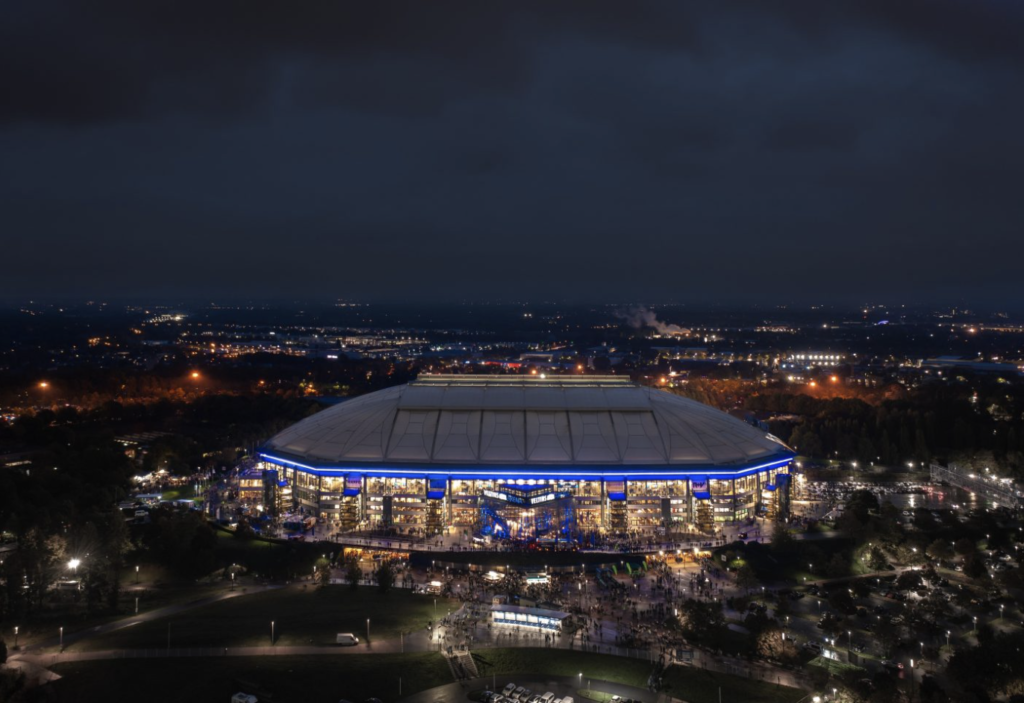
To combat this « death by interest, » management has strategically pivoted toward aggressive asset optimization of their most valuable physical asset. The Veltins-Arena has been successfully transformed into a high-margin global event hub, hosting icons like Taylor Swift and Rammstein, while also generating rental income by leasing the pitch to Shakhtar Donetsk for their European fixtures. This « event machine » strategy was the primary driver behind a crucial €5.5M net profit reported in late 2025, providing the vital liquidity needed to maintain operations while the footballing side of the business undergoes a painful stabilization phase.
2. The Cooperative Lever: Auf Schalke eG
Instead of seeking a predatory billionaire savior—a move strictly restricted by Germany’s 50+1 rule—Schalke is weaponizing its massive membership base through the « Auf Schalke eG » Cooperative, an innovative financial vehicle designed to bypass traditional banking constraints.
- The Mechanism: Members and local businesses buy shares at €250 each, paired with a one-time admin fee to ensure immediate operational cash flow.
- The Goal: This « crowdfunded equity » is specifically earmarked to buy back stadium shares currently held by the City of Gelsenkirchen and retire the club’s most expensive, high-interest loans.
- The Strategy: By converting raw fan loyalty into hard, interest-free capital, Schalke is fundamentally lowering its fixed operational costs for the next decade. They are laser-focused on 2026—the milestone year when the stadium’s original 25-year depreciation cycle finally concludes—as the definitive « Breakeven Point » that will allow them to reinvest 100% of their matchday income back into the first-team squad.
3. The Pivot: Schalke vs. FC Barcelona
Schalke’s crisis management offers a fascinating contrast to FC Barcelona’s famous « Levers » strategy, representing two fundamentally opposite schools of financial thought and institutional survival.
- Barcelona (The Offensive Gamble): Barça aggressively sold off 25% of their future domestic TV rights for 25 years and 49% of their media wing to generate immediate liquidity for blockbuster signings like Robert Lewandowski. It was a high-stakes « spend to earn » model that sacrificed long-term revenue sovereignty to preserve a world-class brand in the immediate present.
- Schalke (The Defensive Marathon): In stark contrast, Schalke has steadfastly refused to sell future media income to private equity or venture capital funds. Instead, they are raising internal equity from their own community through the cooperative. While Barça gambled on external speculation to maintain its elite status, Schalke has accepted the harsh, unglamorous austerity of the second division to ensure that when they eventually return to the top, they own their destiny and their stadium outright.
4. The Transfer Calculus: Cooperative vs. Private Equity
The ultimate test of this model lies in the transfer market, where Schalke must now compete against « Private Equity (PE) » backed clubs that benefit from immediate, aggressive capital injections. While PE-owned clubs can use debt-fueled « war chests » to scout global wonderkids through Multi-Club Ownership (MCO) networks, Schalke is forced to play a disciplined, value-based game. Their transfer budget is now a direct function of operational efficiency and academy output (the Knappenschmiede), rather than owner injections. This creates a « Transfer Ceiling » in the short term, but it protects the club from the « boom-and-bust » cycles and exit-strategy pressures inherent in the PE model, where sporting ambition is often a secondary concern to a fund’s internal rate of return (IRR).
The CashOnThePitch Verdict
Schalke is betting on internal solvency over external speculation, a path that is significantly slower but arguably more resilient. If the cooperative successfully « kills the interest dragon, » Schalke could return to the Bundesliga by 2027 as one of the few debt-free powerhouses in Europe, owning its stadium and keeping every cent of its media revenue. However, this is a binary bet: if the fans do not buy in, the « Member-Owned » model faces its ultimate existential crisis. In Gelsenkirchen, the supporters are no longer just fans in the Nordkurve; they have officially become the club’s primary venture capitalists.