

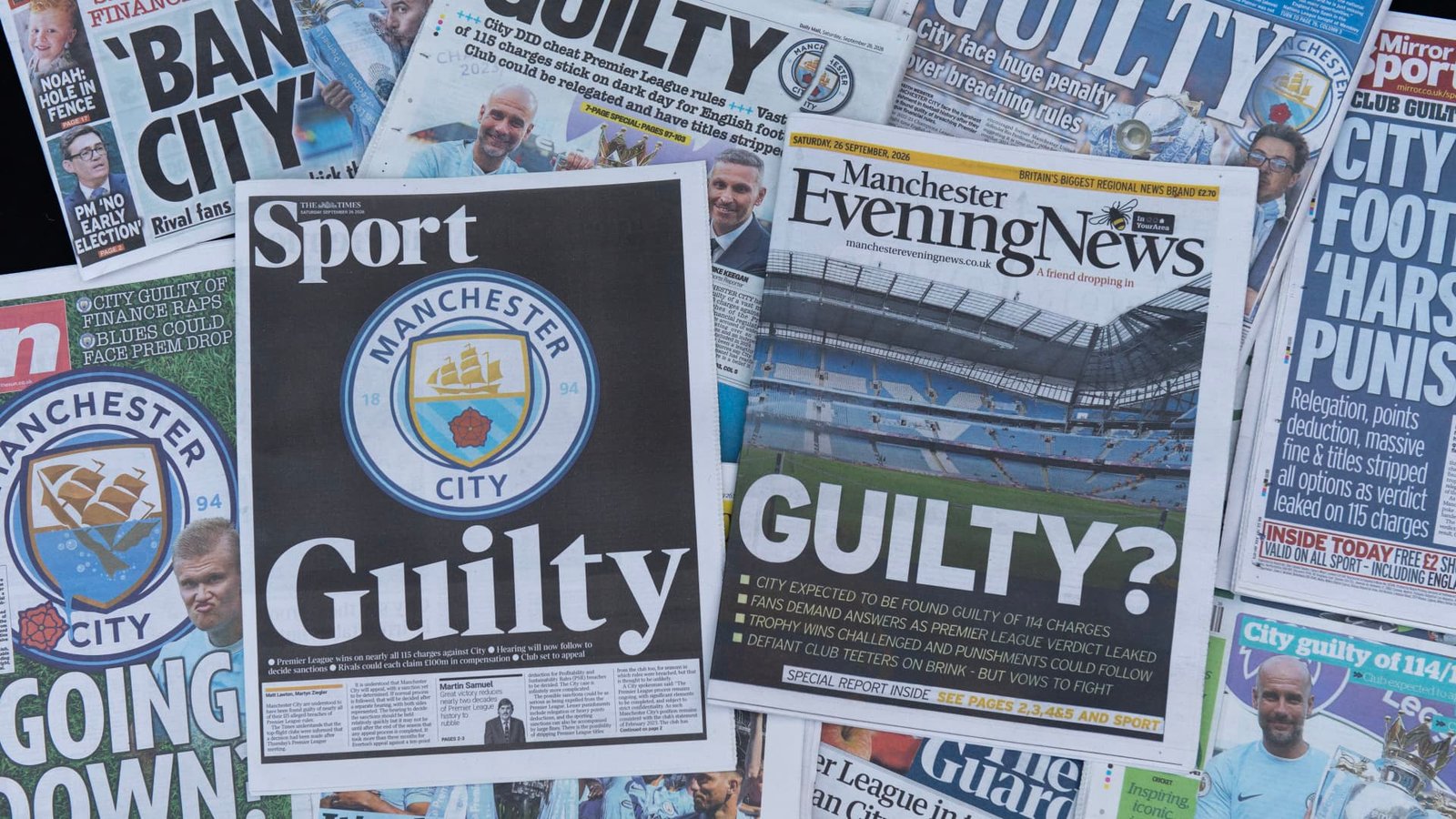
115 charges. Nine seasons. More than £900 million. On 29 September 2026, an independent commission found Manchester City guilty of every financial charge for 2009-10 to 2017-18, and of most non-cooperation charges. City lodged its appeal on 1 October; the sanction is still to be decided.
Officially, this is a story about rules. Unofficially, it’s a story about accounting: what counts as revenue, who is really paying, and what happens when a club’s numbers stop meaning what they say.
What the 115 charges actually are
« 115 charges » isn’t one offence repeated 115 times. The league listed 80 financial breaches from 2009 to 2018, plus 35 for failing to cooperate with its investigation. They cover misstated sponsorship revenue, undisclosed player and manager pay, and Financial Fair Play breaches.
It started with Der Spiegel’s 2018 leaks. UEFA banned City from Europe in 2020, but the Court of Arbitration for Sport overturned the ban. This time, the verdict has stuck, at least for now.
How a « sham » sponsorship works
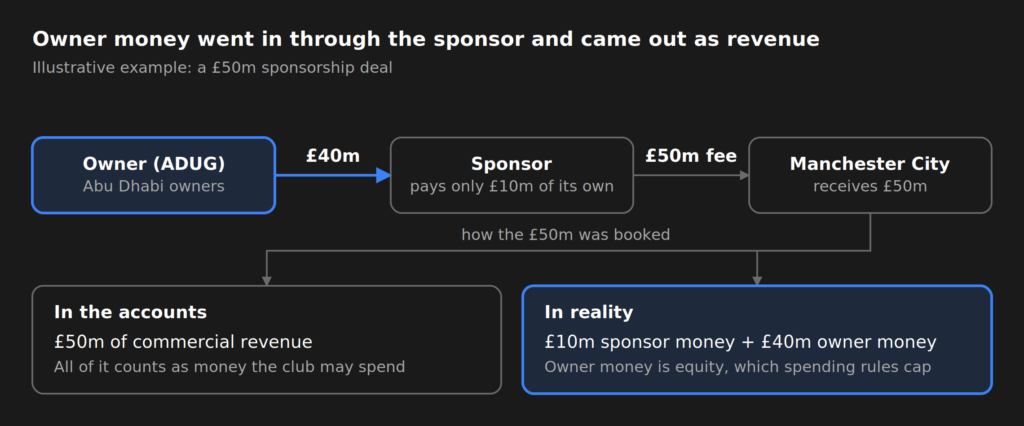
The core finding: several sponsors only paid part of their fees. The rest was quietly funded by ADUG, the Abu Dhabi company that owned the club.
Take an example. A sponsor signs a £50 million deal but really pays £10 million, and the owner covers the other £40 million. The accounts show £50 million of revenue, but in finance that £40 million is equity, a capital injection, not revenue.
Why does the label matter? Under Financial Fair Play, revenue is money you are allowed to spend; owner money above a set limit isn’t. Same cash, different label, completely different spending power.
Costs got the same treatment, including players’ image rights paid through Fordham, an entity also funded by ADUG. In plain terms, part of the wage bill was moved off City’s books.
The £900 million question
Add it all up and the league says City’s schemes inflated revenue and reduced costs by more than £900 million over nine seasons. More than £830 million of that was owner funding dressed up as sponsorship.
That’s roughly £100 million a season, for a club whose total revenue was £694.1 million in 2024-25 and far smaller back then. The commission’s key finding: reported accurately, City would have broken the spending limits by a very substantial amount.
Why revenue was the whole game
Financial Fair Play ties what a club can spend to what it earns. That turns reported revenue into a licence: the bigger the number, the more you’re allowed to spend on transfers and wages.
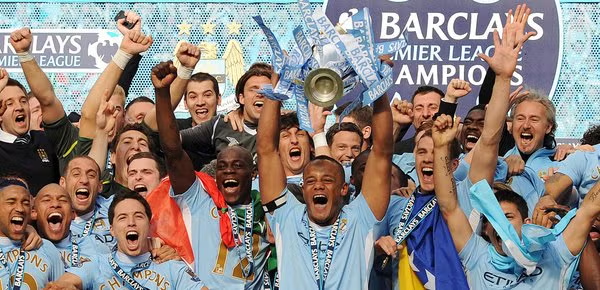
That creates a flywheel. Inflated revenue unlocks spending, spending buys better players, better players win trophies, and trophies bring real revenue: bigger sponsors, more prize money, more broadcast picks. City’s first trophy in 35 years, the 2011 FA Cup, and its first Premier League title in 2012 both fall inside the period covered by the charges.
Think of a start-up that overstates early sales to raise money: by the time the truth comes out, the business is genuinely huge. You can’t unwind nine years of compounding.
The Bill, Part one: Sanctions
Under Rule W64, the commission can fine City, deduct points or expel it. The sanction will be set at a separate, private hearing.
Everton lost 10 points, later cut to six, for one three-year overspend. Finance expert Kieran Maguire suggests adding « a zero » for City: 40 to 60 points. Even 40 would have left City 18th last season.
Timing is a problem too. Punish City before the appeal and it could be relegated, then cleared. Wait, and rivals may lose European places or their league status.
The Bill, Part two: Compensation
This could outgrow any fine. Everton were ordered to pay Burnley around £35 million, after Burnley argued it would have survived relegation in 2021-22 had Everton been punished that season. Apply that to City, and rivals could claim lost titles, Champions League places or relegations across nine seasons.
Damages are what a club would have earned minus what it did earn. Until settled, those claims are a contingent liability: a cost that may never arrive, but that any buyer or lender has to price in.
The Bill, Part three: What it does to the business
To see where a sanction would hurt, look at City’s latest accounts.
| Manchester City, 2024-25 | £M |
|---|---|
| Commercial revenue | 340.4 |
| Broadcast revenue | 278 |
| Matchday revenue | 75.1 |
| Total revenue | 694.1 |
| Staff costs (58.8% of revenue) | 408 |
| Pre-tax result | -9.9 |
Wages are largely fixed; revenue isn’t. A deduction that costs Champions League football cuts income while the £408 million wage bill stays. That’s operating leverage working in reverse.
Add a record £352.9 million of transfers in 2024-25 and around £460 million this summer, and relegation would mean selling players fast, and forced sellers rarely get full price.
Relegation is the tail risk, not the base case. But even the middle scenarios hit the one line the original schemes were designed to protect: revenue.
The Bigger Picture
What’s interesting here isn’t really the size of the fine City might pay. It’s what the case says about football’s numbers. Every financial rule in the game, from Financial Fair Play to today’s squad cost limits, assumes that reported revenue is real.
If a club can relabel owner money as sponsorship for nine seasons, every rule built on revenue is built on sand. The verdict sends a clear message to owners everywhere: in football finance, the label on the cash matters as much as the cash itself.
But the timeline sends a message too. The leaks came out in 2018. The verdict arrived in 2026, and the appeal is only starting.
If it takes eight years to check the accounts, can financial rules ever move as fast as the money they are supposed to control?