Roman Abramovich did not put Chelsea up for sale because he had lost interest in football. He was running out of time.
On 2 March 2022, days after Russia invaded Ukraine, he announced that he would sell the club he had financed for nineteen years. He pledged the net proceeds to victims of the war. Eight days later, the UK government sanctioned him and froze his British assets, leaving Chelsea operating under a special licence.
A club accustomed to discussing trophies and transfers suddenly faced questions about what it could sell, spend and pay. Finding a buyer became urgent.
Four years later, Chelsea has new owners, a radically different squad and a financial structure that takes some unpicking. Todd Boehly, once the public face of the takeover, is leaving. Clearlake Capital is taking control. Behind those boardroom changes lies a question that matters far beyond Stamford Bridge: how do you turn an extraordinarily expensive football club into a business that can support itself?
A sale under pressure
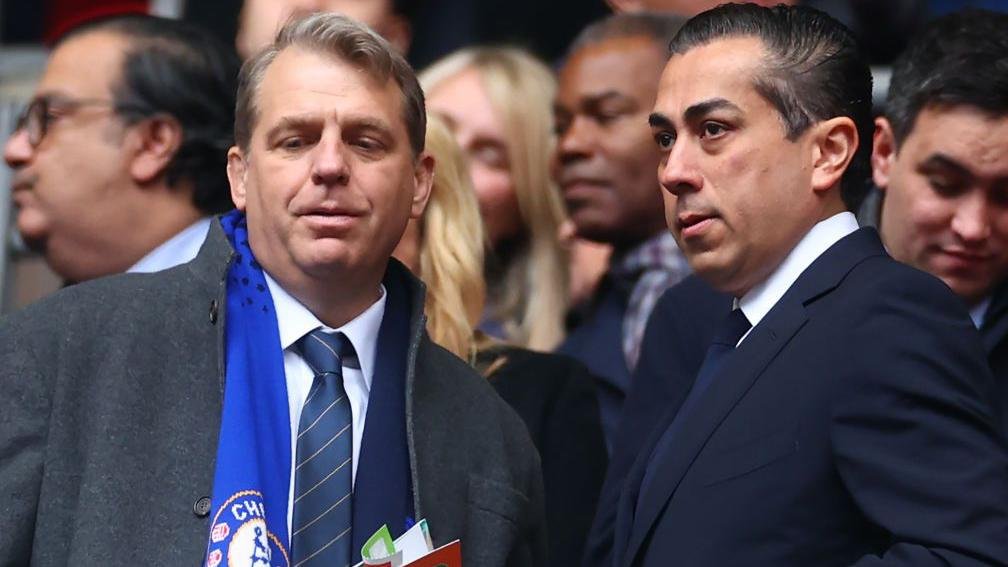
Selling a major football club usually involves months of negotiations. Chelsea had little room for delay. Investment bank Raine Group ran the auction while the government worked out how a sale could proceed without benefiting Abramovich.
Around 200 parties reportedly expressed interest. The serious contenders included the Ricketts family, owners of the Chicago Cubs; a consortium led by former British Airways chairman Sir Martin Broughton; and American sports investor Steve Pagliuca. A late bid from INEOS founder Sir Jim Ratcliffe failed to displace the preferred buyers: a group led by Boehly and California-based private equity firm Clearlake.
The takeover completed on 30 May 2022. Its £4.25 billion headline figure covered two different commitments. The buyers paid £2.5 billion for the club’s shares and promised a further £1.75 billion of investment in Chelsea, including its stadium and other facilities.
Only the first amount was the purchase price. The rest was money the new owners committed to putting into the club after acquiring it. That distinction would become increasingly relevant as their spending accelerated.
Abramovich had been willing to fund Chelsea for years through interest-free loans. The incoming investors had a different task: improve the team, develop the business and eventually justify the billions they had committed.
Who owns what?
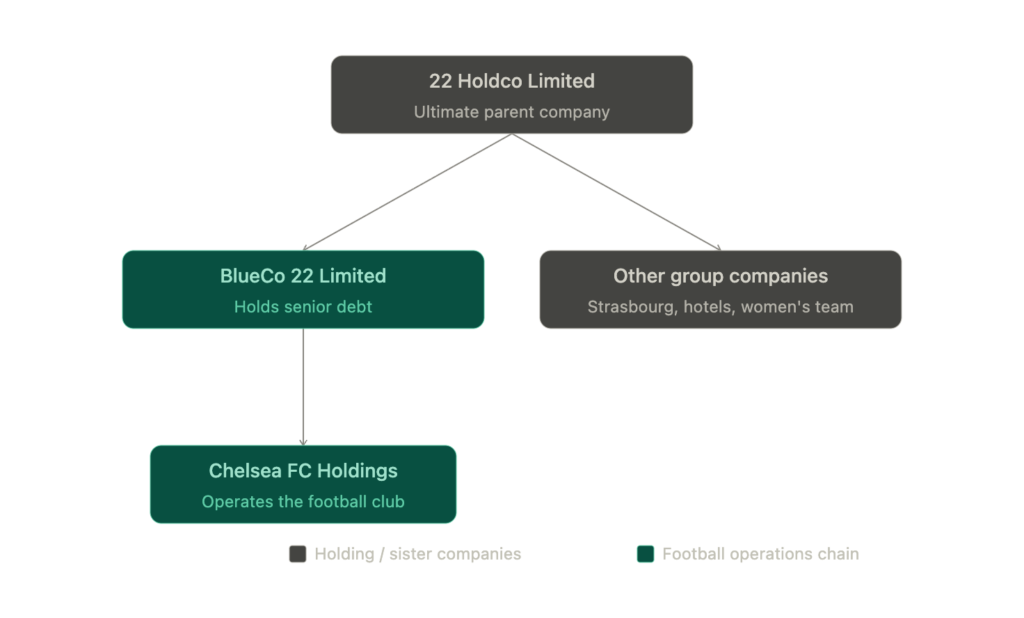
Boehly attracted much of the attention, but Clearlake supplied the majority of the ownership capital and initially held about 61.5% of the equity. Boehly, fellow Dodgers owner Mark Walter and Swiss billionaire Hansjörg Wyss held the rest.
The ownership group became known as BlueCo. Its companies sit at different levels: 22 Holdco Limited is the ultimate parent, BlueCo 22 Limited sits below it, and Chelsea’s own companies sit further down. Other businesses and assets, including Strasbourg, also form part of the wider group. This arrangement matters because the accounts for Chelsea alone do not show everything happening above it. A loan owed by a parent company will not necessarily appear as bank debt in the club’s own accounts. Equally, a profit recorded by one subsidiary may disappear when the whole group’s accounts are combined. Think of a parent company owning two businesses. If one sells a building to the other, the seller can record a gain in its own accounts. But the parent still owns the same building. Taken together, the businesses have not earned anything from an outside buyer.
Keep that distinction in mind. It explains much of the controversy that followed.
Buying players & spreading the cost
The new owners wasted little time rebuilding the squad. Enzo Fernández arrived in January 2023, followed by Moisés Caicedo that summer, both for fees above £100 million. They were part of a spending programme that produced one of the most expensive squads ever assembled. The fees drew headlines. The contracts deserved attention too.
Chelsea gave several players deals lasting seven or eight years, far longer than the usual three to five. Those contracts secured players for longer, but they also offered an accounting advantage. When a club buys a player, it normally spreads the transfer fee across the player’s contract in its accounts. This is called amortisation. A £100 million signing on a five-year contract creates an annual expense of £20 million. Spread the same fee over eight years, and the annual expense falls to £12.5 million. The player has not become cheaper. Chelsea still owes £100 million, and the dates on which it pays the selling club depend on their separate payment agreement. Amortisation determines when the cost appears in the accounts, not when the cash leaves the bank. For a club judged partly on its annual losses, that timing is useful. Smaller yearly charges leave more room for spending within the financial rules. The remaining expense is pushed into later years.
There is a risk, though. A long contract also means a long wage commitment. If the player disappoints, gets injured or no longer fits the manager’s plans, the club may struggle to move him on. Selling him for less than his remaining accounting value creates another loss.
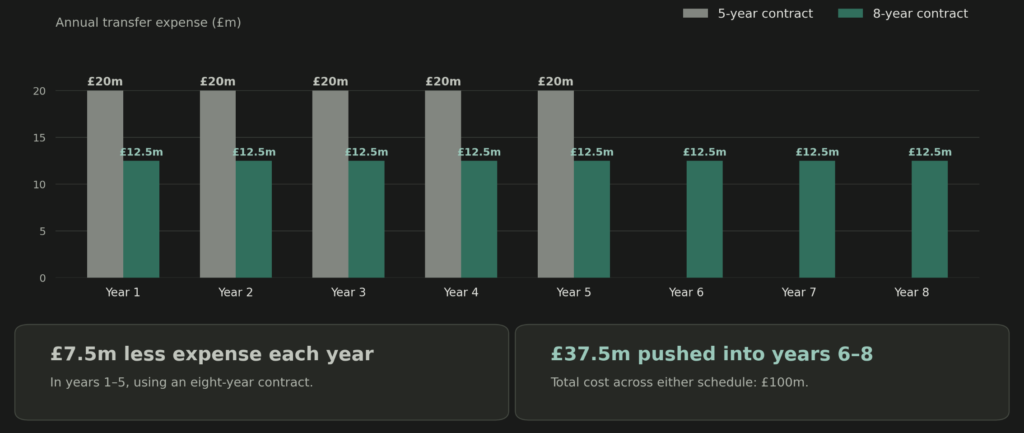
UEFA and the Premier League subsequently introduced five-year limits on transfer-fee amortisation for their financial rules. Longer playing contracts remained possible, but the accounting benefit was curtailed for deals covered by the new limits.
Chelsea had used the rules available to it. Those rules could ease the immediate pressure, but they could not remove the eventual cost.
The sales that stayed inside the group
Contract length was only part of Chelsea’s approach. The club also sold assets to other companies under the same ownership.
In 2023, two hotels beside Stamford Bridge were transferred to a sister company for about £76.5 million. In June 2024, the women’s team was transferred within the group at a value of £198.7 million. These deals helped the selling company’s accounts. An asset sold for more than its recorded value can generate an accounting profit, even when the buyer is another company belonging to the same owners. But the wider group has not become richer simply by moving an asset between subsidiaries. Nor should the gain be confused with recurring income from tickets, sponsors or broadcasters. It is a transaction that can improve one set of accounts without improving the underlying football business.
That makes the regulatory treatment crucial. The Premier League’s Profitability and Sustainability Rules assess adjusted losses over a rolling period. Under the framework applicable to these transactions, clubs could generally incur losses of up to £105 million over three years, subject to owner funding and other conditions. Certain spending could be excluded from the calculation. Related-party transactions also raise a valuation question: would an independent buyer pay the same price? A deal between companies with a common owner does not test the market in the way an open sale does.

UEFA applies its own financial rules and adjustments. A transaction that helps a club’s domestic calculation may not provide the same benefit in Europe. There is therefore no single “financial fair play loss” that can be read straight from the annual accounts. Chelsea’s published loss, the Premier League’s adjusted figure and UEFA’s assessment answer different questions. Treating them as interchangeable makes the finances look simpler than they are.
Where the pressure shows up
Chelsea FC Holdings reported revenue of £490.9 million for the year ending June 2025 and a pre-tax loss of £262.4 million. The previous year’s £128.4 million profit had benefited from the sale of a subsidiary. That is why a profitable year on paper did not necessarily mean the everyday business had become profitable.
At the top of the ownership structure, 22 Holdco reported a much larger pre-tax loss of £700.8 million. This covered the wider group, with additional financing costs, acquisition-related accounting charges and adjustments that arise when subsidiaries are combined. Neither number should be described simply as cash lost during the year. Accounting losses include expenses that do not involve a matching cash payment in that period. Even so, repeated heavy losses put pressure on the owners to provide funding and improve performance. Debt adds another demand on the business. The draft’s financial figures put borrowing across the group at roughly £1.4 billion, including about £794 million of senior bank debt due in July 2027 and a separate loan of around £596 million from Ares Management.
The Ares financing illustrates another useful distinction. Interest can be added to a loan balance instead of being paid immediately in cash. This preserves cash today, but leaves a larger amount to repay later. The debt grows even when the borrower is following the agreement. A maturity date does not necessarily mean the owners must repay everything from cash on hand. They may refinance: take out a new loan to replace the old one. Whether that is affordable depends on lenders’ confidence, interest rates and the condition of the business at the time.
Meanwhile, UEFA has required Chelsea to bring its football finances into line. The settlement published in July 2025 included an €80 million potential fine: €20 million unconditional and up to €60 million dependent on compliance with its targets. Chelsea also accepted a separate penalty for its squad-cost ratio. The message was clear enough. The owners could continue backing the club, but regulatory limits still constrained how much of that money could be spent on football.
Results are part of the business plan
For supporters, the ownership changes have been accompanied by a disorienting succession of managers and players. Thomas Tuchel was dismissed early in the new regime. Graham Potter followed, then Frank Lampard as interim manager, then Mauricio Pochettino. Enzo Maresca arrived in 2024. Each change brought another attempt to make an expensive, evolving squad work.
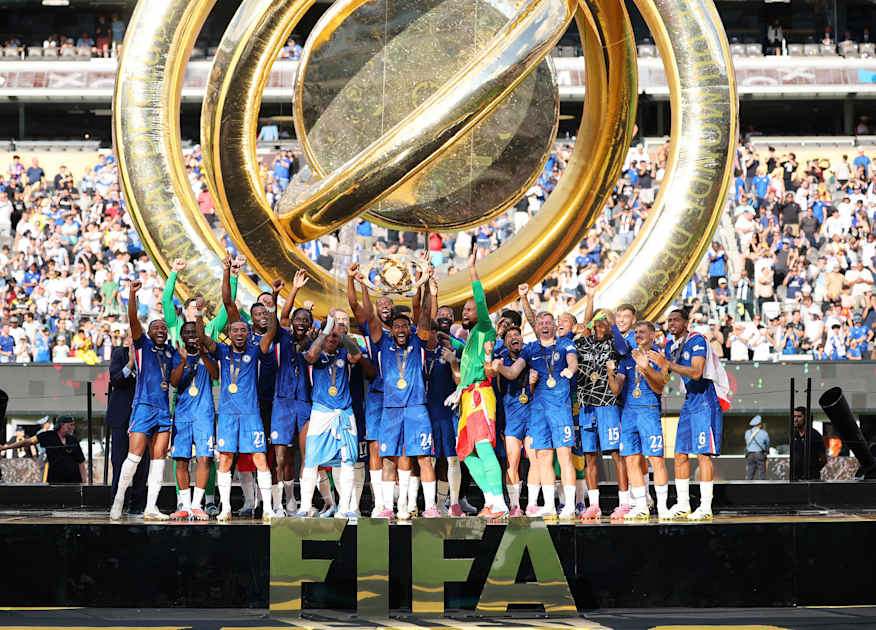
Chelsea finished 12th in the first full season after the takeover, then sixth, then fourth in 2024/25. There were important successes: the 2025 Conference League title and a 3–0 win over Paris Saint-Germain in the expanded Club World Cup final. Those trophies count. They brought prize money, visibility and evidence that the investment could produce results. But a business carrying substantial wages, transfer costs and debt needs dependable income as well as occasional triumphs.
Champions League qualification is especially valuable. It brings broadcasting and prize money, attracts commercial interest and helps a club recruit and retain players. Missing out can leave a large hole in the budget while many of the costs remain fixed. Chelsea’s financial ambitions therefore depend on something no ownership structure can guarantee: winning enough matches, season after season.
Stamford Bridge’s limits
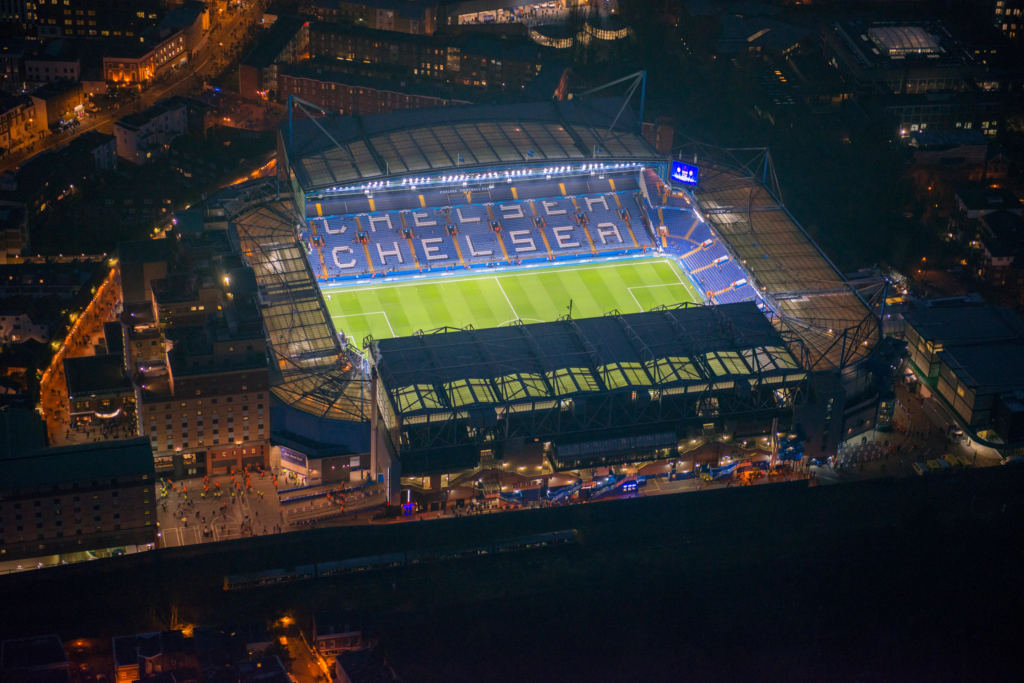
There is also a constraint that cannot be solved in the transfer market. Stamford Bridge holds around 40,000 people. Arsenal and Tottenham have stadiums with capacities above 60,000. More seats can mean more ticket income. Modern hospitality facilities can increase what a club earns from each match, while concerts and other events can bring in money outside the football calendar. For Chelsea, improving the stadium offers a way to grow revenue without depending entirely on results.
Getting it built is another matter. Stamford Bridge occupies a cramped site, making major redevelopment difficult. Rebuilding could require Chelsea to play elsewhere for years. A move to Earl’s Court has also been discussed, but competing development plans complicate that possibility. Both routes involve planning, disruption and a large funding commitment. A bigger stadium might strengthen the business for decades; paying for it would add to the demands on the owners long before those benefits arrived.
Clearlake takes control
In September 2026, Chelsea announced that Clearlake would acquire Boehly’s and Walter’s interests, with Boehly leaving his role as chairman. The announcement ended a partnership in which the most recognisable owner had not been the largest shareholder.
Reports put the consideration at about £950 million and the wider valuation near £5 billion, including debt. Equity value is the value attributable to shareholders. Enterprise value generally adds net debt to that figure to describe the value of the business across its main sources of financing. A £5 billion enterprise valuation does not mean shareholders would receive £5 billion for their shares. For illustration, paying £950 million for a 25.6% stake implies an equity value of about £3.7 billion, assuming all shares have equivalent economic rights. Debt can help explain the difference between that figure and the larger headline valuation. The precise calculation depends on the terms of the transaction and the debt and cash included. Nor does a higher equity valuation automatically establish a strong investment return. That requires knowing how much shareholders invested after the original takeover, what they received along the way and what they ultimately get back.
The buyout settles who will lead the project. It does not settle whether the project will earn enough to justify its cost. Chelsea’s owners have bought players, rearranged assets and raised financing on an enormous scale. Some of those decisions bought time. Some may create lasting value. The test now is whether the club can generate enough reliable income to support the team and the business around it. That work will be measured in full stadiums, commercial contracts, manageable borrowing and regular Champions League appearances. And, every weekend, in results.
Sources: Bloomberg, Financial Times, CNBC, Reuters, The Swiss Ramble, The Esk (Paul Quinn’s Analysis Series), ESPN, The Athletic, BBC Sport, UEFA, and the Premier League.