


Apollo, one of the world’s largest investment firms, just published a report that should change how every club owner, fan, and investor thinks about the business of sports.
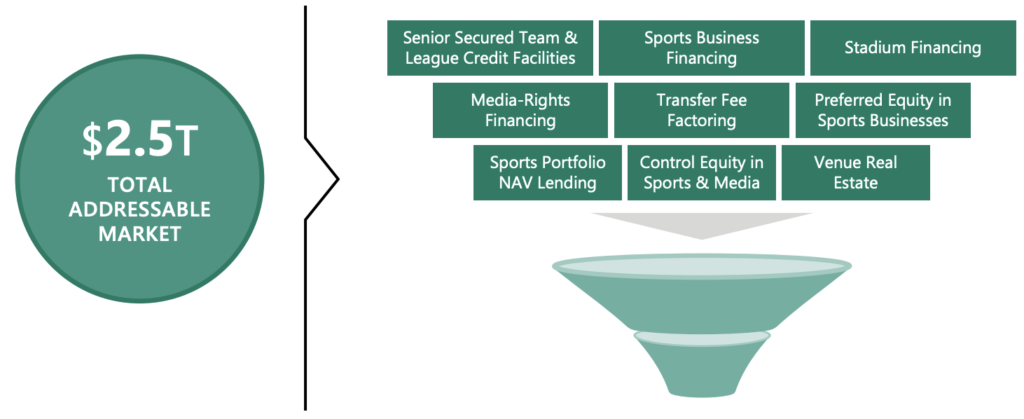
The investment firm believes there’s a $2.5 trillion investment opportunity in sports that most people are still missing. Not just football, the whole thing: leagues, stadiums, media deals, merchandise, fitness, live events, data. The full ecosystem.
To put that in perspective? It’s bigger than the entire GDP of Russia, Brazil, or Spain.
The Paradox
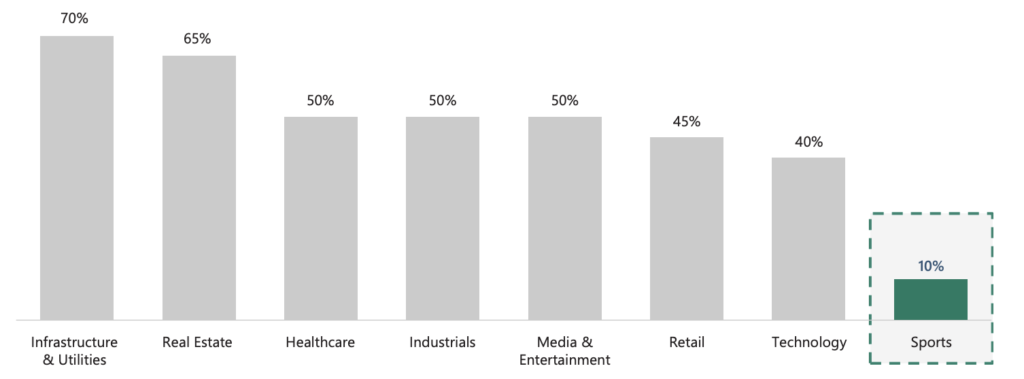
Imagine you own a building worth £500 million. The rent comes in every month, you’ve never missed a payment in 60 years. One day, imagine you walk into a bank, and they offer you a mortgage worth… 10% of the building’s value. You’d laugh them out of the room. But that’s exactly what’s happening in professional sports right now. Apollo’s analysts looked at how much debt sports franchises carry versus what they’re actually worth.
The average loan-to-value ratio across the NFL, NBA, MLB, and NHL? Just 10%. Compare that to real estate: 65%. Healthcare: 50%. Media and entertainment: 50%. Even retail, an industry that’s been struggling for years, gets financed at 45%. That’s the financing gap. And Apollo just raised $6 billion to step into it.
Source: Apollo Report 2025
Why Are Sports Worth So Much?
Before we get into the money mechanics, let’s understand why sports valuations have gone to the moon.
Apollo says sports is the last truly live entertainment asset. In an on-demand world, almost everything is skippable.Live sport is different. When the penalty goes in at the 94th minute, 70,000 people in the stadium and 100 million watching at home experience the exact same thing at the exact same second. That shared, unscripted, uncontrollable moment is what makes sports irreplaceable. And broadcasters know it, which is why the numbers have become almost absurd:
∙ The NFL’s current broadcast deals will pay out more than $110 billion in total. That’s $10 billion per year
∙ The NBA just signed an 11-year, $76 billion deal with Amazon, ESPN, and NBC. The previous deal was worth $24 billion. It more than tripled.
∙ Formula 1 just sold its US rights to Apple TV+ for $140 million per year — up from $85 million with ESPN.
Every time rights come up for renewal, the number goes up. And it’s been going up for 60 years without stopping.
Better than the S&P500?
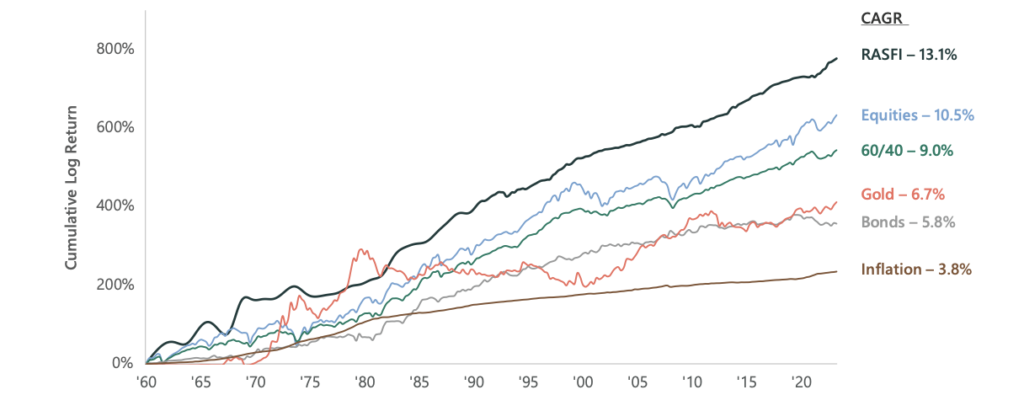
Apollo tracked franchise valuations back six decades using something called the Ross-Arctos Sports Franchise Index (a database of every major North American franchise transaction since the 1960s).
The result: sports franchises have compounded in value at 13.1% per year for 60 years. For context:
∙ The S&P 500 (the US stock market): 10.5% per year
• Gold: 6.7% per year
∙ Bonds: 5.8% per year
And through crashes, recessions, pandemics, and wars, sports assets are culturally entrenched and unusually resilient, fandom doesn’t behave like a normal consumer product.
Sources: University of Michigan, Ross-Arctos Sports Franchise Index (RASFI)
Who’s Been Investing?
For decades, sports leagues, especially in the US, actively blocked outside investors. The four major US leagues (NFL, NBA, MLB, NHL) were built on the idea that franchises should be owned by individuals, not funds. It was a cultural thing as much as a financial one. But valuations got so high that the old model started breaking. A team that cost $50 million in 1990 costs $5 billion today. So the leagues started opening the door. In Europe, football was ahead of the curve. Private equity investment in Europe’s top five football leagues went from €66 million in 2018 to €10.6 billion in 2023. That’s a 160x increase in five years!
What Apollo Actually Wants to Do
They’ve built a dedicated business, Apollo Sports Capital, and they want to deploy $6 billion into it.
Their strategy isn’t mainly buying clubs (though they did buy 55% of Atlético Madrid in late 2025, go see our article: https://cashonthepitch.com/boardroom-showdown-in-madrid-apollos-1-billion-gamble-on-atletico/).
Their bigger bet is on the financing gap itself. Most club owners have a lot of cash on paper, their franchise is worth billions, but cash-poor in reality. They can’t easily sell part of the team, and banks won’t lend them much against it. Apollo wants to be the lender who actually understands the asset. Instead of treating a Premier League club like an unpredictable small business, they treat it like what it actually is: an infrastructure asset with long-dated, contractually-guaranteed cash flows.
The structures they’re offering:
∙ Senior secured loans backed by franchise equity (you get liquidity without selling control)
∙ Stadium and media-rights financing (borrow against your long-term TV deal like you’d borrow against a property)
∙ Hybrid capital — part debt, part equity upside — targeting returns in the high single to low double digits, with downside protection
Their target is structures that attach at 0% of enterprise value and detach between 30-60%. Meaning Apollo gets paid before equity holders in a downside scenario, but participates in upside through warrants or profit participation. Credit-like risk, equity-like return.It’s the same logic that’s made private credit one of the fastest-growing parts of finance, and it’s now coming for sport.
That’s the $2.5 trillion opportunity in Apollo’s world: not that sports is suddenly “a new thing,” but that it’s a large, durable ecosystem that has not yet been financed like one.
Source: Apollo Analysts
But…
Apollo’s $2.5 trillion figure includes apparel, footwear, fitness, wellness, live entertainment, and basically anything that touches human physical activity. The actual investable universe for a firm like Apollo is much, much smaller.
What they’re really targeting is the financing stack of professional sports franchises and infrastructure: the sliver of the $2.5 trillion where their credit and hybrid structures can actually plug in.
But it still tells you about the downstream demand. The more people spend on sport in every form, the more valuable the franchises and the rights that sit at the centre of it all become.
The Apollo report is available free on their website. If you want to understand where the serious money in sports is going — it’s worth 20 minutes of your time.