

In the high-stakes world of sports broadcasting, « reach » and « revenue » are often at odds. For the last three years, Major League Soccer (MLS) and Apple operated on a « premium-first » philosophy, locking every match behind a standalone MLS Season Pass paywall. But as we look toward the 2026 season, that strategy has been dismantled in favor of a massive pivot to the mainstream.
Here is the breakdown of why the paywall fell, the tactical shift at Apple, and what this means for the league’s bottom line.
The News: The Death of the Gated Community
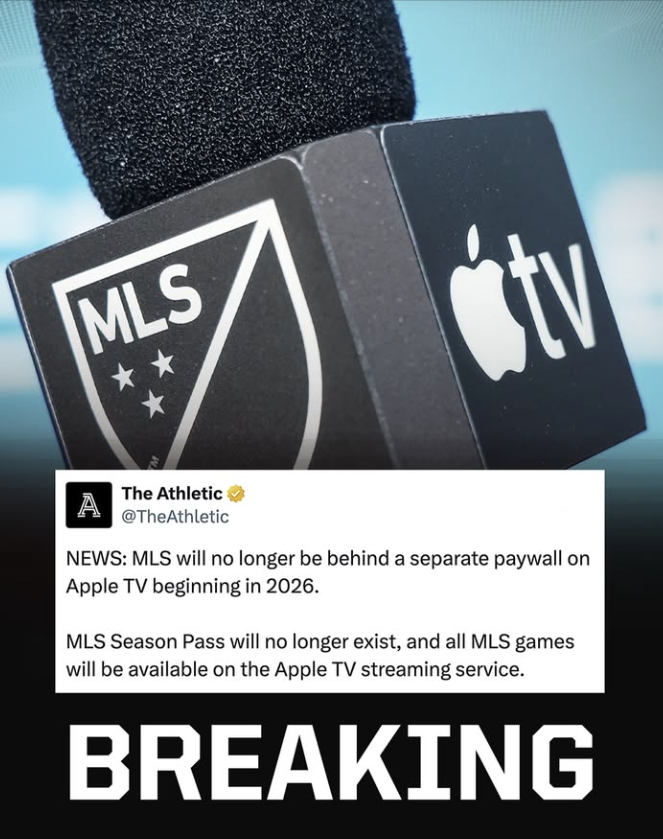
In November 2025, reports from league sources and Apple Support confirmed a seismic shift: starting in 2026, MLS Season Pass will no longer exist as a separate subscription. Since the partnership began in 2023, fans were required to pay up to $14.99 a month (or $99 a year) on top of an Apple TV+ subscription to watch the league. Moving forward, all matches—including the regular season, Leagues Cup, and the MLS Cup Playoffs—will be integrated directly into the standard Apple TV+ subscription ($12.99/month) at no additional cost.
The catalyst for this change was a clear trend in Apple’s sports strategy. When Apple acquired Formula 1 rights, it notably bypassed the « Season Pass » model, folding the races into the base service. Furthermore, the recent launch of a $14.99 bundle between Apple TV+ and NBC’s Peacock effectively created a « super-hub, » bringing the Premier League, F1, and MLS under one affordable roof. By removing the separate paywall, MLS and Apple are trading niche subscription fees for mass-market visibility.
The Apple Strategy: Ecosystem Glue over Standalone Profit
For Apple, the death of Season Pass isn’t a failure; it’s a repositioning of live sports as « ecosystem glue. »

1. Eliminating Friction
The « Season Pass » experiment was an ambitious test of whether a league could thrive entirely behind a dedicated paywall. The results were mixed. While the arrival of Lionel Messi provided a massive initial spike, data suggests that the hurdle of a second subscription deterred casual fans. By folding MLS into the base tier, Apple moves from a potential audience of 2 million dedicated subscribers to over 40 million Apple TV+ households worldwide.
2. Retention and Bundling
Apple’s business model is less about individual product sales and more about « Services » revenue and hardware stickiness. Sports are the ultimate anti-churn tool. If a fan subscribes to watch Inter Miami, they are more likely to stay and watch Ted Lasso or Severance. By bundling MLS with F1 and MLB’s « Friday Night Baseball, » Apple is building a comprehensive sports portfolio that makes their $12.99/month price point feel like an steal compared to traditional cable or bloated streaming competitors.
The MLS Financials: Reach, Revenue, and the 2029 Exit
While « more viewers » is a win for the fans, the financial restructuring of the $2.5 billion deal is where the real drama lies. Moving matches into the base tier required a significant renegotiation of the original 10-year contract.

1. The Renegotiated Payout
The original deal was set to run through 2032. Under the new agreement, the contract has been shortened by three years, now ending in mid-2029.
- The Cash Injection: Apple will pay MLS roughly $50 million more over the next four years than originally planned to compensate for the loss of direct subscription revenue.
- The « Sprint » Season: In early 2027, as MLS transitions to a « European-style » fall-to-spring calendar, Apple will provide a one-time payment of $107.5 million for a shortened transition season.
- The Floor: Annual payments are expected to rise from $250 million to approximately $275 million.
2. From Subscription Share to Ad Inventory
The original 2022 deal included a « upside » trigger where MLS would keep 50% of every dollar once Season Pass exceeded a certain number of subscribers. With Season Pass gone, that upside is effectively neutralized.
In its place, the financial focus shifts to Advertising. With an audience that Portland Timbers owner Merritt Paulson expects to « double » by 2026, the value of ad spots during « MLS 360 » (the league’s whip-around show) and mid-game commercials becomes the primary engine for growth. MLS has reportedly secured more control over local sponsorship inventory, allowing clubs to monetize their broadcast presence more effectively.
3. The 2029 Gamble
The shortening of the deal to 2029 is the most strategic financial move. MLS is betting that the 2026 World Cup will be the « jet fuel » that finally ignites American soccer culture. By going back to the open market in 2029—three years early—MLS hopes to leverage a much larger audience to spark a bidding war between Apple, Amazon, and traditional broadcasters like ESPN or NBC.
The Bottom Line
The « Season Pass » era was a bold, necessary experiment that proved the viability of global streaming but highlighted the limitations of the paywall. By tearing down that wall, MLS is positioning itself to be visible at the exact moment the world turns its eyes toward North America for 2026. For Apple, it’s about scale; for MLS, it’s about ensuring that when the « jet fuel » of the World Cup arrives, the engine is already running.